Seeing blood after a bowel movement can be alarming. Although rectal bleeding is often caused by common and treatable conditions such as piles or anal fissures, it should not simply be dismissed as normal.
The colour, amount and pattern of the bleeding may provide useful clues, but they cannot confirm the cause on their own. What matters is knowing when the bleeding should be checked and what to expect during an assessment.
This article explains what different types of rectal bleeding may look like, the possible causes and how a doctor may investigate where the blood is coming from.
Rectal bleeding does not always appear in the same way. Depending on where the bleeding originates and how much blood is present, you may notice:
Although the colour and appearance of the blood can provide useful clues, they cannot confirm where the bleeding is coming from or what has caused it.
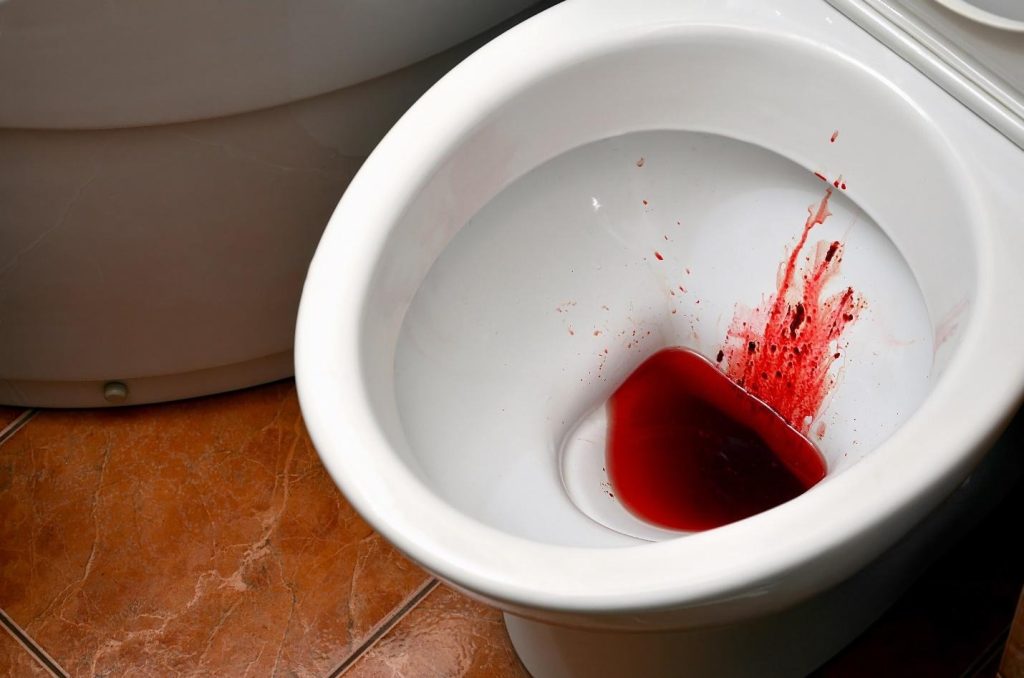
The colour of the blood may provide clues about where bleeding has occurred, but it cannot establish the cause by itself.
| Appearance | What it may indicate |
| Bright-red blood | Often comes from the anus, rectum or lower colon. Possible causes include haemorrhoids, anal fissures and other lower bowel conditions. |
| Dark-red or maroon blood | May indicate bleeding from farther inside the colon or small intestine, although the appearance can vary depending on the amount and speed of bleeding. |
| Black, sticky or tar-like stool | May indicate that blood has been digested after bleeding higher in the digestive tract, such as the stomach or upper small intestine. |
| No visible blood | Small amounts of bleeding may only be detected through a stool test or investigations for iron-deficiency anaemia. |
It’s important to note that food, supplements and medicines can sometimes alter stool colour. However, black or red stools should not be attributed to food or medication without considering the possibility of bleeding.
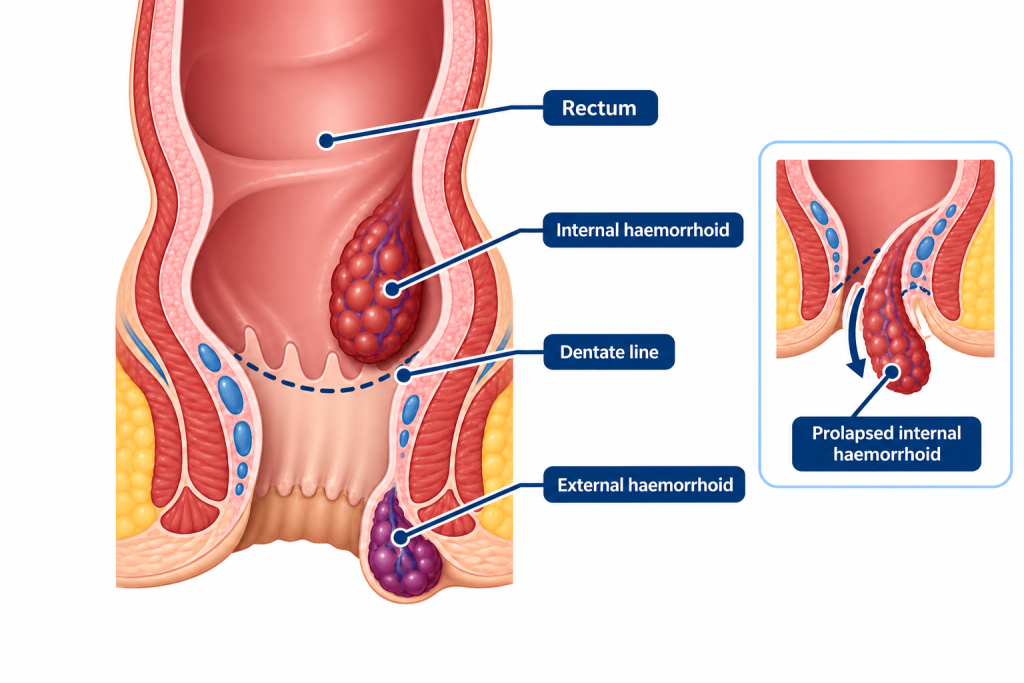
Piles, also known as haemorrhoids, develop when the blood vessels and supporting tissues within or around the anus become enlarged or displaced.
Haemorrhoidal tissue is a normal part of the body and helps support the anal canal. It becomes a problem only when it swells, prolapses or begins causing symptoms such as bleeding, discomfort, itching or a lump.
Piles are broadly divided into two types according to where they develop:
| Feature | Internal haemorrhoids | External haemorrhoids |
| Location | Develop inside the anal canal, above the dentate line | Develop beneath the skin around the anus, below the dentate line |
| Typical symptoms | Bright-red bleeding, mucus, irritation or prolapse during bowel movements | Swelling, itching, tenderness or a noticeable lump near the anus |
| Pain | Often painless unless they prolapse or develop complications | More likely to be painful because the surrounding skin contains more pain-sensitive nerves |
| Can they protrude? | Yes. Larger internal haemorrhoids may prolapse through the anus | They are located externally and may be felt as a lump |
| Potential problem | Prolapse that may require manual reduction | A blood clot may form, causing a suddenly painful thrombosed haemorrhoid |
A person can have internal and external haemorrhoids at the same time. Symptoms can also overlap, so the presence of bleeding, pain or a lump does not always reveal which type is responsible.
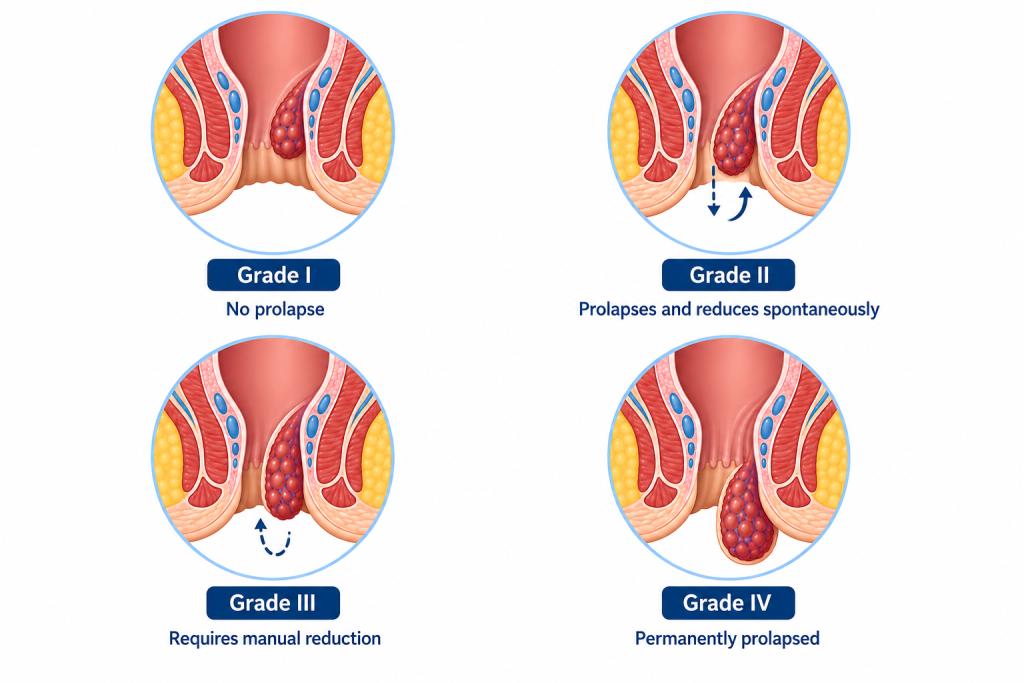
Internal haemorrhoids are classified into four grades according to whether they prolapse and whether they return inside on their own.
| Grade | Degree of prolapse |
| Grade I | The haemorrhoids remain within the anal canal and do not prolapse. |
| Grade II | The haemorrhoids prolapse during a bowel movement or straining but return inside on their own. |
| Grade III | The haemorrhoids prolapse during a bowel movement or straining and must be gently pushed back inside. |
| Grade IV | The haemorrhoids remain prolapsed and cannot be pushed back inside. |
Piles and anal fissures are common causes of rectal bleeding, but they are not the only possibilities. Bleeding can originate anywhere from the anus to the upper digestive tract.
An anal fissure is a small tear in the lining of the anus. It commonly develops after passing a hard or large stool and typically causes sharp or burning pain during or after a bowel movement.
The bleeding is usually bright red and may appear on toilet paper or along the outside of the stool. Unlike internal haemorrhoids, which may bleed without causing pain, an anal fissure often produces noticeable discomfort.
Colorectal polyps are growths that develop on the lining of the colon or rectum. Most polyps do not cause symptoms, but some may bleed.
The blood may appear on the stool, be mixed within it or occur in amounts too small to be seen. Although most polyps are not cancerous, certain types can develop into colorectal cancer over time. Polyps found during a colonoscopy can usually be removed and sent for laboratory examination.
Inflammatory bowel disease includes conditions such as ulcerative colitis and Crohn’s disease. These conditions cause ongoing inflammation within the digestive tract, which may lead to ulcers and bleeding.
Bleeding caused by inflammatory bowel disease may occur with:
The symptoms can vary and may alternate between periods of activity and remission.
Diverticula are small pouches that develop in weak areas of the colon wall. Rectal bleeding can occur if a blood vessel within one of these pouches bursts.
Diverticular disease-related bleeding is often painless and may begin suddenly. In some cases, the amount of blood can be substantial.
This is different from diverticulitis, which occurs when the pouches become inflamed or infected. Diverticulitis more commonly causes abdominal pain, fever, nausea or changes in bowel habits.
Colorectal cancer may cause visible rectal bleeding or smaller amounts of blood that are only detected through a stool test.
Other possible symptoms include:
These symptoms do not necessarily mean that cancer is present. However, persistent bleeding should be investigated because colorectal cancer may not produce obvious symptoms during its earlier stages.
Bleeding can also begin in the oesophagus, stomach or upper part of the small intestine. Possible causes include stomach ulcers, inflammation of the stomach lining and enlarged blood vessels within the oesophagus or stomach.
As the blood travels through the digestive tract, it may be partially digested and cause black, sticky or tar-like stools. Upper gastrointestinal bleeding may also cause vomiting of fresh blood or dark material resembling coffee grounds.
Black, tar-like stools should be medically assessed promptly, particularly when accompanied by dizziness, weakness, breathlessness or abdominal pain.
A small amount of bleeding on a single occasion does not always indicate a serious condition. Nevertheless, medical assessment is advisable when the bleeding:
Rectal bleeding should also be assessed when its pattern changes, even if haemorrhoids have previously been diagnosed. The presence of piles does not exclude another source of bleeding.
Seek emergency medical attention if the bleeding is heavy, continuous or accompanied by symptoms suggesting significant blood loss.
Warning signs include:
An assessment for rectal bleeding is not only intended to confirm whether haemorrhoids are present. It also helps determine whether the bleeding could be coming from another part of the anus, rectum or digestive tract.
The assessment usually begins with a discussion about your symptoms. Dr Aaron Poh may ask:
A physical examination may then be performed. This can include inspecting the area around the anus for external haemorrhoids, fissures, swelling or other abnormalities. A digital rectal examination may also be used to check the lower rectum for blood, lumps or other changes.
If internal haemorrhoids are suspected, an anoscopy or proctoscopy may be performed. These examinations use a short instrument to allow the doctor to inspect the anal canal and lower rectum more closely.
Further investigations may be recommended when the source of bleeding is uncertain or when the symptoms suggest another bowel condition. These can include:
Not everyone with rectal bleeding requires a colonoscopy. The investigations recommended will depend on the pattern of bleeding, accompanying symptoms, examination findings and individual risk factors.
Seeing blood after a bowel movement can be worrying. Although piles are a common cause, rectal bleeding can also occur for several other reasons, and its appearance alone cannot confirm what is causing it.
If the bleeding keeps returning, changes in pattern or occurs with other bowel symptoms, it is worth getting checked rather than continuing to assume it is piles.
At Alpine Surgical Practice, Dr Aaron Poh provides assessment for rectal bleeding, haemorrhoids and other colorectal concerns. Contact us to arrange a consultation and understand what may be causing your symptoms.
No. Piles commonly cause bright-red bleeding, but anal fissures, colorectal polyps and other bowel conditions can produce a similar appearance. The colour of the blood cannot confirm the cause by itself.
Yes. Internal haemorrhoids often cause painless bright-red bleeding because they develop in an area with fewer pain-sensitive nerves. Pain is more likely when haemorrhoids prolapse, become trapped or involve the sensitive skin around the anus.
Yes. The presence of haemorrhoids does not exclude polyps, inflammation or another source of bleeding. Further investigation may be recommended when the bleeding pattern or accompanying symptoms cannot be fully explained by haemorrhoids.
No. The need for a colonoscopy depends on factors such as the appearance and duration of the bleeding, accompanying symptoms, examination findings and personal or family history.
No. A faecal immunochemical test can detect blood in the stool, but it cannot identify haemorrhoids or determine exactly where the bleeding originated. Further assessment may be required to establish the cause.
A small, isolated episode may sometimes settle without treatment. However, you should seek medical advice if the bleeding returns, increases, has no clear explanation or occurs alongside changes in bowel habits, abdominal symptoms, weight loss or unusual fatigue.
Seek emergency medical attention if the bleeding is heavy or continuous, the toilet water turns red, you pass large blood clots or you experience dizziness, fainting, breathlessness, confusion or severe pain.


Copyright © Alpine Surgical Practice | Terms & Conditions


